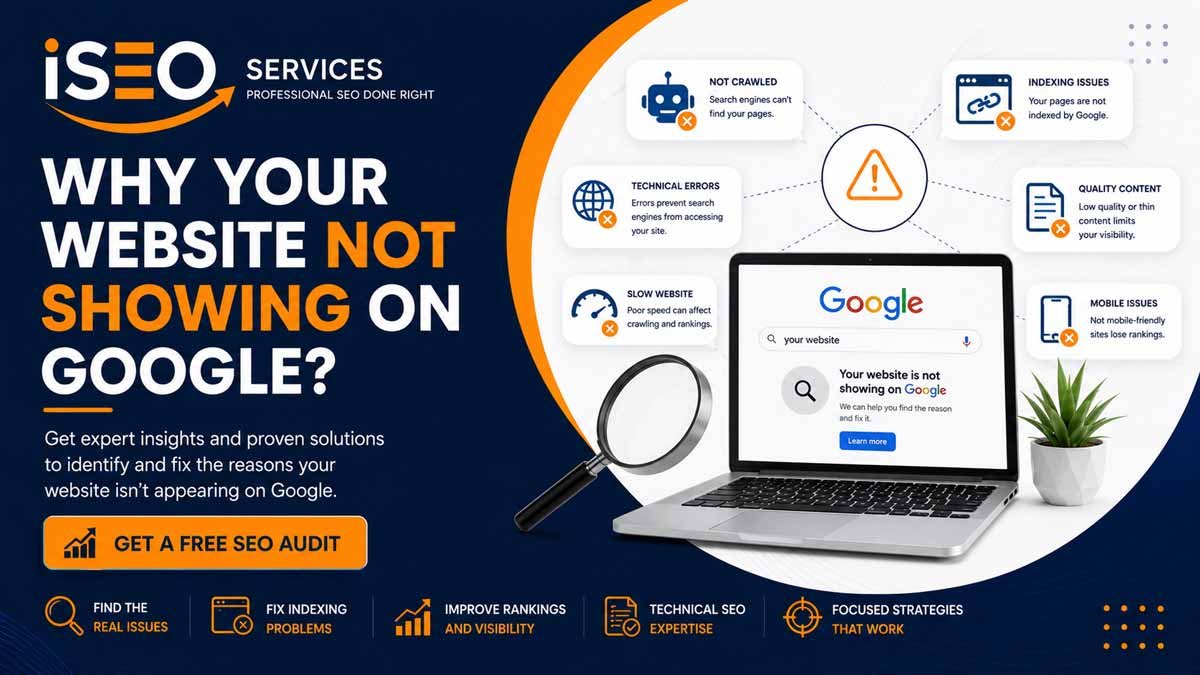
If you are asking, "why is my website not ranking on Google?" or "why is my website not getting traffic?" you are navigating a challenge faced by millions of digital properties. While SEO is often viewed as a linear process, Google’s algorithms utilize over 200 ranking signals to determine visibility. Seeing your website not appearing in search results can be a symptom of technical friction, content gaps, or a lack of domain authority. This guide analyzes the primary google ranking issues preventing your success and provides a data-driven roadmap to recovery.
Quick Check: Why is my website not showing on Google?
Before performing a deep technical audit, evaluate these common "blockers" that often explain why site is not showing on Google:
- Indexing Status: Your site is not indexing due to technical directives like a noindex tag.
- Domain Age: New sites often experience a "seasoning" period where Google validates credibility before ranking.
- Manual Penalties: A violation of Google's Search Essentials (formerly Webmaster Guidelines).
- Search Intent Mismatch: Your content does not align with what the user is actually looking for.
- Competitive Gap: The target keywords exceed your current "Link Equity" or authority level.
1. Your Site is Not Indexed (The "Why My Site is Not Indexing" Problem)
The most fundamental website not ranking on Google reasons is a lack of indexing. If your site is not in the index, it cannot compete. To verify this, perform a "site:" search (e.g., site:iseoservices.com); if no pages return, your site is invisible to the crawler.
The Fix: Open Google Search Console (GSC) and review the "Indexing" report. Ensure you have not inadvertently implemented a noindex meta tag in your <head> section or blocked essential directories via your robots.txt file. Additionally, verify that your XML Sitemap is submitted and successfully "Fetched" by Googlebot.
2. Manual Actions and Quality Penalties
A website not ranking on Google might be suffering from a Manual Action. This occurs when a human reviewer determines a site violates Google’s spam policies. While algorithmic shifts are common, manual actions are specifically issued for deceptive practices like hidden text or structured data abuse.
3-Step Diagnostic Guide:
- Log into Google Search Console.
- Navigate to the Security & Manual Actions tab.
- Review Manual Actions. If the status is "No issues detected," your site is in good standing. If a penalty exists, you must rectify the specific violation and submit a Reconsideration Request.
3. Technical Performance: Core Web Vitals
Google utilizes Mobile-first indexing, prioritizing the mobile version of your content for ranking. As of 2021, Core Web Vitals (LCP, FID, and CLS) became official ranking signals, linking user experience directly to visibility. If your page load speed is sluggish, your google ranking issues will likely persist.
The Fix: Use PageSpeed Insights to audit your "Loading," "Interactivity," and "Visual Stability." Ensure your site uses HTTPS, as security remains a baseline requirement for modern search.
4. Competitive Density and Keyword Difficulty
If you are wondering "why my website is not ranking on Google" for high-volume terms, it may be due to "Keyword Difficulty." Dominating "head terms" often requires significant backlink profiles that smaller or newer domains lack.
Strategic Adjustment: Pivot to long-tail keywords. Data suggests that long-tail queries often have a higher conversion rate because they capture users further along in the buying cycle. Target specific phrases like "SEO services for retail in India" rather than just "SEO."
5. Aligning Content with Search Intent
Google’s "Helpful Content" system prioritizes intent satisfaction. If a user seeks information but finds a sales pitch, the page will likely fail to rank. Understanding whether a query is Informational, Navigational, or Transactional is critical for content mapping.
| Intent type | User goal | Content recommended |
|---|---|---|
Informational | Learning/Research | Blogs, "How-to" Guides |
Navigational | Finding a specific brand | Homepage, Contact Page |
Transactional | Completing a purchase | Product Pages, Service Packages |
6. The "Sandbox" Period for New Domains
While not an official Google term, the "Sandbox" effect describes the observation that new websites often struggle to rank for several months. Google requires time to establish a "Trust Score" and verify the consistency of your content.
New Site Expectations | Established Site Metrics |
|---|---|
Crawl Frequency: Low/Infrequent | Crawl Frequency: High/Daily |
Rankings: Limited to branded/long-tail | Rankings: High-volume competitive terms |
Authority: Building initial signals | Authority: Sustained link equity |
7. Content Depth and "Helpfulness"
Following the March 2024 Core Update, Google has intensified its focus on reducing "unhelpful" content by up to 40%. Thin or derivative content that adds no unique value is frequently de-indexed or suppressed.
The Fix: Audit your content for "Information Gain." Ask if your page provides insights not found in the top 5 search results. Incorporate original data, expert quotes, or proprietary case studies to satisfy E-E-A-T requirements.
8. Backlink Profile and Domain Authority
Backlinks remain a top-three ranking factor. If your competitors have 100 high-quality referring domains and you have five, your website not ranking on Google is a matter of "Authority Gap."
Action Plan: Focus on "Earned Media" rather than "Built Links." Create linkable assets, such as industry reports or unique tools, that naturally attract citations. Avoid "Link Schemes" or buying cheap links, as these can lead to future algorithmic suppression.
9. User Experience (UX) and Design Friction
High bounce rates and low "dwell time" can signal to Google that your page isn't satisfying the user. While UX is subjective, technical elements like intrusive interstitials (pop-ups) are known to negatively impact mobile rankings.
Optimization: Ensure your design is "clean" with a clear visual hierarchy. Use whitespace effectively and ensure your Call-to-Action (CTA) does not obstruct the main content.
10. Keyword Cannibalization and Duplication
When multiple pages on your site target the exact same keyword, you create "Keyword Cannibalization." This confuses Google’s ability to determine the "preferred" URL, often resulting in lower rankings for both pages.
The Fix: Use rel="canonical" tags to point Google to the master version of a page. If two pages are nearly identical, consider a 301 redirect to consolidate their ranking power into a single, stronger asset.
11. Robots.txt Misconfigurations
Your robots.txt file acts as a gatekeeper. A single "Disallow: /" command can prevent search engines from crawling your entire domain, leading to your site not indexing.
Validation: Use the "Robots.txt Tester" in GSC. Ensure that your CSS and JS files are not blocked, as Google needs to "render" the page to understand its layout and quality.
12. Over-Optimization and "Spammy" Signals
Stuffing keywords into every H2 and Alt-tag is a legacy tactic that now triggers spam filters. Modern SEO relies on Latent Semantic Indexing (LSI) and Natural Language Processing (NLP) to understand context.
Best Practice: Write for the human reader first. Use your primary keyword in the H1 and first 100 words, then utilize synonyms and related concepts throughout the body text to maintain a natural flow.
Conclusion
Successfully navigating the digital landscape, where Google utilizes over 200 ranking signals, requires more than a simple checklist. The 12 factors, ranging from foundational issues like indexing status and Core Web Vitals to strategic challenges such as competitive density and content depth, collectively underscore the need for a continuous, expert-led approach.
Algorithmic changes, such as the March 2026 Core Update’s focus on helpfulness, mean that sustained visibility is an ongoing operational commitment, not a one-time fix.
If your business is still asking, "why is my website not ranking on Google?" after addressing basic fixes, the issue likely lies in the complexity of enterprise-scale technical SEO or the need for a targeted content authority strategy. To overcome these complex obstacles and ensure your website achieves sustainable, authoritative rankings, consider partnering with professional SEO services that are equipped to handle modern search challenges, including LLM and AI-driven optimization. This partnership allows you to move beyond troubleshooting and focus on market leadership.